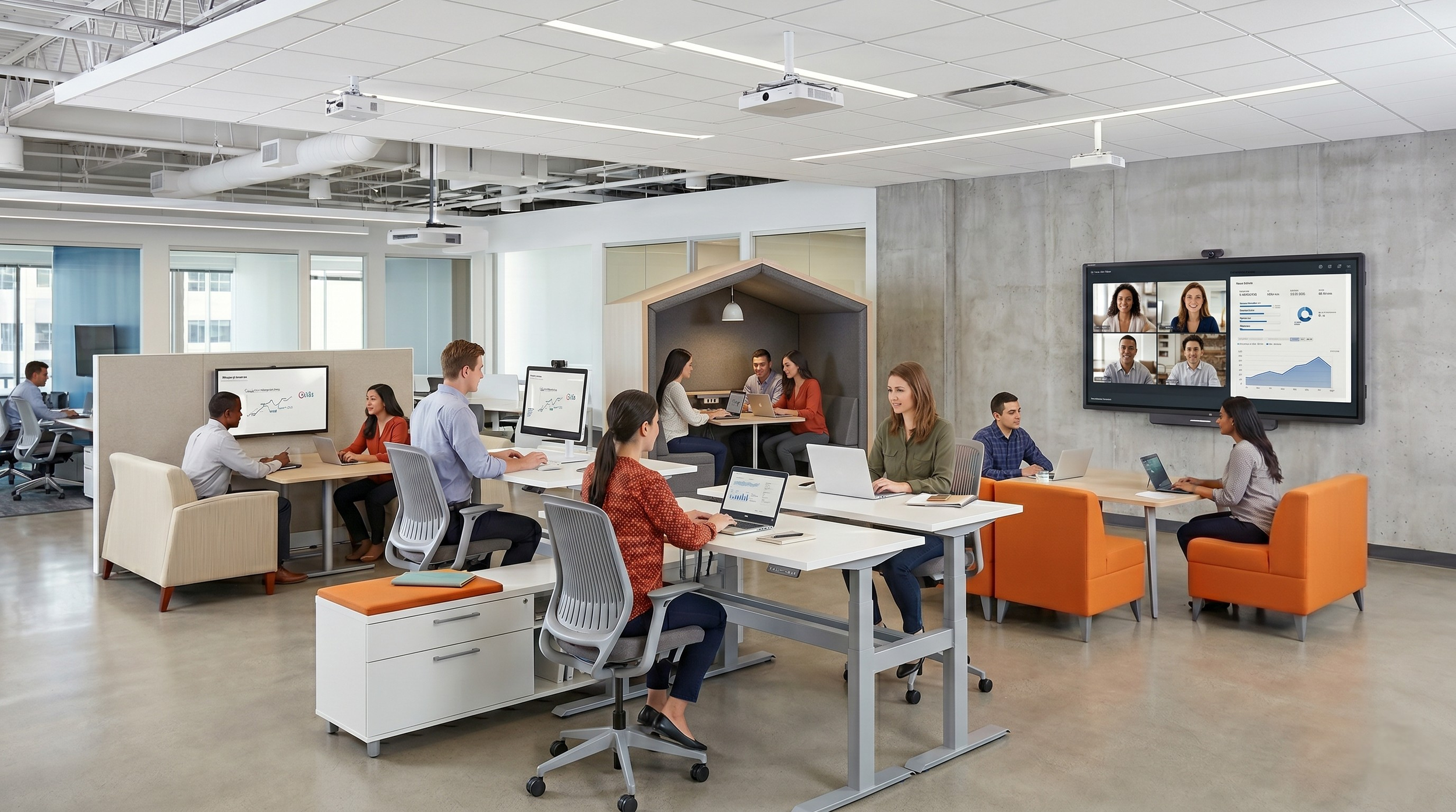
The End of Silos: Why Facility Planning is Going Unified
For years, the process of outfitting a professional space followed a predictable, albeit fractured, path. Facilities managers chose the furniture, IT departments handled the hardware, and AV specialists tucked the wiring wherever it would fit. These were treated as separate line items, separate budgets, and separate conversations.
Today, that model is officially obsolete. We are witnessing a fundamental shift in how leading organizations—from municipal offices and 911 dispatch centers to corporate headquarters and university campuses—approach their physical environments. The era of the "smart office" is being replaced by the Integrated Ecosystem.
Beyond the "Smart" Label: The Integrated Ecosystem
In the past, adding "smart" technology to a building often meant retrofitting existing spaces with standalone gadgets. In an Integrated Ecosystem, the technology and the physical environment are no longer two separate entities; they are a single, cohesive infrastructure.
This means the furniture, the network, and the AV systems are designed to "talk" to one another from day one. Whether it is a height-adjustable workstation that integrates seamlessly with specialized dispatch hardware or a classroom where the acoustics respond automatically to the start of a video lecture, the goal is Unified Infrastructure.
The Death of Siloed Procurement
Purchasing agents and decision-makers are increasingly moving away from buying IT and furniture separately. The risks of the old "siloed" model have become too high to ignore:
Mismatched Tech: Furniture that arrives without the proper cable management or power capacity for modern hardware.
Redundant Spending: Overlapping costs when contractors and vendors are not aligned on the same spatial goals.
Operational Friction: Users struggling with "clunky" setups that hinder performance rather than helping it.
Why Leading Organizations are Designing for Unity
Why are we seeing this shift toward a single budget item for technology and physical space? The answer lies in three key institutional priorities:
Efficiency and ROI: When IT, AV, and furniture are procured as a unified solution, installation time is slashed, and the likelihood of costly "day-two" fixes is eliminated. One budget means one vision.
Future-Proofing: Integrated ecosystems are built to scale. As technology evolves, the physical environment is already designed to support the next generation of hardware without requiring a total renovation.
The User Experience: Whether it’s a government employee, a student, or a first responder, people expect technology to work intuitively with their surroundings. Seamless integration reduces frustration and increases productivity.
Market Trend: The Convergence of AV, IT, and Commercial Design
As we move into this new era of institutional planning, the most successful organizations will be those that bring IT, Facilities, and Procurement to the table at the same time. By treating technology and commercial design as a converged discipline, you ensure that your infrastructure is as resilient as the mission it supports.
The silos are falling. It’s time to start building ecosystems, not just rooms.